Step 1: Write down what you have, today
Before anything else, get your record straight. Dates, minutes, what kind of hour it was, the site, and which supervisor. If it is in your head or in a paper diary, put it somewhere that will still exist in two years.
Do not wait until the dispute is settled. A record written during the work is worth far more than one written after the argument started.
Step 2: Ask in writing, and be specific
Email, not a corridor conversation. Name the exact period, the exact totals, and the exact thing you want signed. Ask for a date by which they will reply. Keep the email.
A surprising number of cases end here. A supervisor who has been avoiding a vague "can you sign my hours?" will often deal with a clear list and a date.
Step 3: Ask why
There are usually only a few real reasons, and they need different answers.
- They disagree with the numbers. Then you need to compare records line by line. This is solvable.
- They are worried about their own liability. Ask what would make them comfortable. Sometimes it is signing period by period instead of years at once.
- They are busy or avoidant. Dates and reminders help. So does a signature that takes one minute instead of an afternoon.
- It is being used against you. A signature held back to keep you in a job, or to settle a personal dispute, is a different problem. Go to step 4 quickly.
Step 4: Escalate inside the organisation
If you work in an agency, there is almost always someone above your supervisor: a clinical director, a training director, an HR lead. Bring your written record and your written requests, not a complaint about a person.
Ask whether another qualified supervisor at the organisation can verify the hours they have direct knowledge of.
Step 5: Contact your board, and ask a question rather than filing a fight
Boards deal with this. Ask them what they accept when a supervisor will not or cannot sign. Some will look at other evidence. Ask in writing and keep the reply. Do not assume the answer from what someone said in a forum, including this page.
Step 6: Keep working and keep logging
Whatever happens with the disputed period, do not stop recording the hours you are doing now. People lose a second year while fighting about the first one.
How a proof pack helps
HourSign can produce a proof pack: one PDF, called Record of hours and signature requests, that shows what you logged and what you sent, with dates.
- Every entry in the period: the date, what it was, the hours, the site, the supervisor.
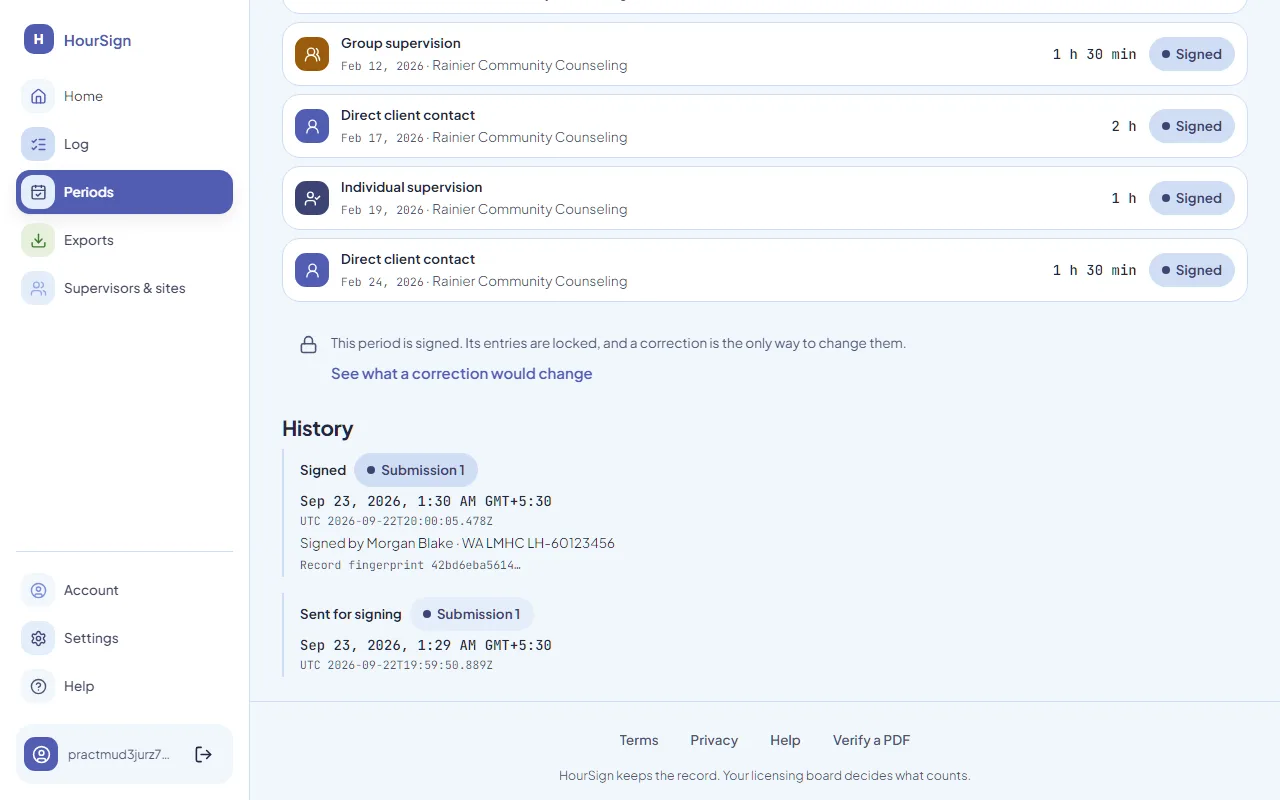
- When the period was created and when you submitted it for signature.
- Every reminder that was sent, to which email address, on which date.
- Every time the review link was opened.
- Whether it was returned, withdrawn or signed, and when.
It does not prove a supervisor was wrong, and it is not a substitute for their signature. What it does is replace "I asked them loads of times" with a dated list that anyone can read. That is usually the part you cannot reconstruct later.
The proof pack is built from HourSign's own records, so it only covers what happened inside HourSign. If you chased your supervisor by text and in person, keep that evidence too.
The thing to do before this ever happens
Get each period signed as you go, not at the end. A supervisor signing one week takes a minute. A supervisor being asked to sign two years takes courage they may not have. See how HourSign works and what to do if they leave.