Step 1: Try to reach them anyway
A person who left a job has not left the profession. Look for them in the state license register, in a professional directory, or on a practice website. A polite email that asks for one signature, with the exact period and totals attached, is a small thing to ask.
Make it as easy as possible. A supervisor who has to dig through old records will put it off. A supervisor who only has to read a finished record and sign will usually do it.
Step 2: Find out who holds the records now
If you worked in an agency, the agency still has your timesheets, your rota and your case allocation. Ask for a copy while you still work there, or as soon as you can. Those records do not belong to your supervisor.
Step 3: Look for a second person who knows
Another qualified supervisor, a clinical director, or a colleague who sat in the same group supervision may be able to verify part of it from their own direct knowledge. They cannot invent knowledge they do not have, and you should not ask them to.
Step 4: Ask your board what it accepts
This is the step most people skip. Boards have seen this before. Ask in writing what evidence they accept when a supervisor is unavailable, and keep the reply. The answer differs by state and by license type, so do not take a forum answer as fact.
Step 5: Do not redo the year in your head
Rebuilding twelve months of hours from memory produces numbers you cannot defend, and a board audit is exactly where that falls apart. Use records that existed at the time: calendars, timesheets, billing systems, your own log.
How a proof pack helps
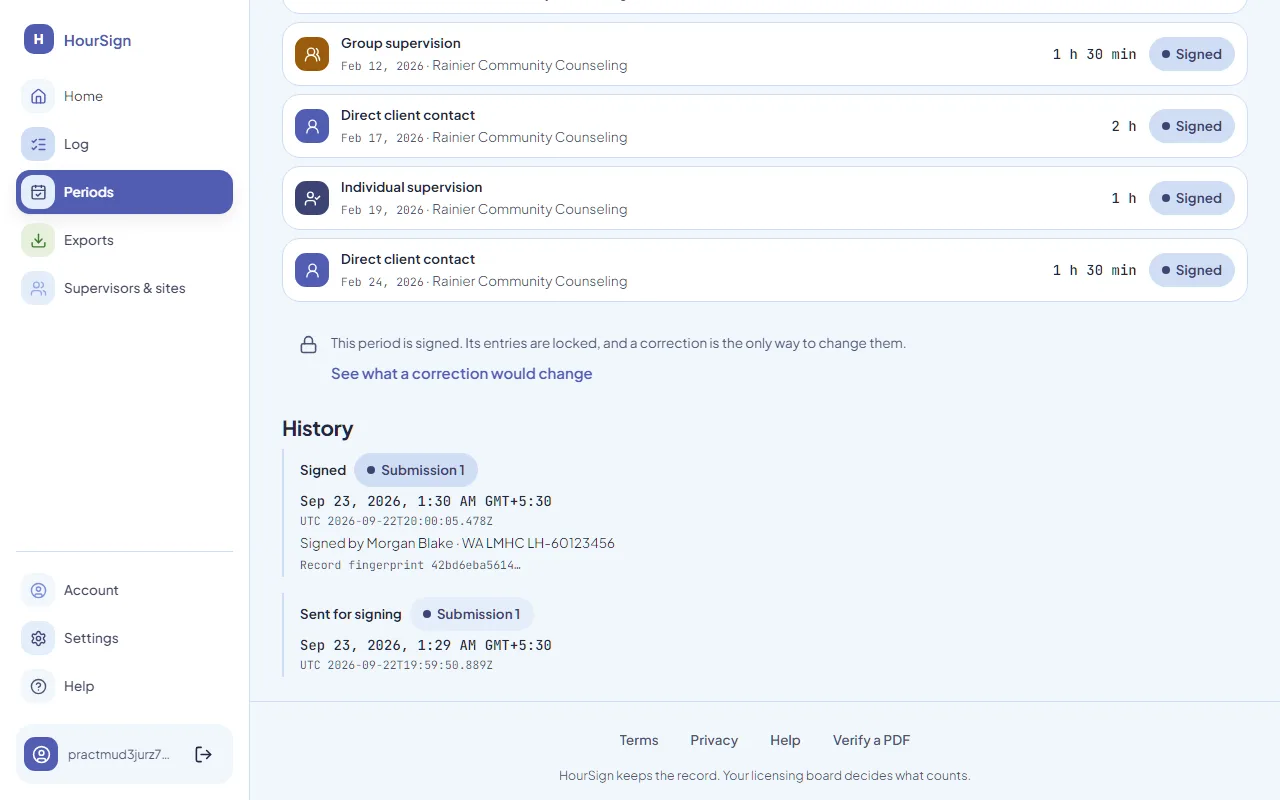
HourSign can produce a proof pack: one PDF, called Record of hours and signature requests, built from HourSign's own records.
- Every entry in the period, with dates, hours, site and supervisor.
- When the period was created and when you sent it for signature.
- Every reminder HourSign sent, to which email address, and when.
- Every time the review link was opened, which shows the request reached someone.
- The period's status: submitted, returned, withdrawn or signed.
This is not a signature and it does not pretend to be one. It is a dated, readable record of what you logged and what you asked for, made at the time rather than remembered afterwards. When you go to your board or to a new supervisor, that is the difference between a story and a document.
The one habit that prevents all of this
Get every period signed while your supervisor is still in front of you. Weekly or monthly, not at the end. A signature is a minute's work when the work is fresh and a crisis when it is two years old.
If your supervisor is still there but will not sign, see my supervisor will not sign my hours.